
Case study · Shopify · Redesign
Bugstick
Bugstick sells a humane catch-and-release insect tool designed in Australia, and arrived with an audience already talking about it. We did not rebuild the store. We redesigned key shopping pages, worked on the friction in the customer journey, and have kept improving and maintaining the site since.
| Platform | Engagement | Industry | Region | Live site |
|---|---|---|---|---|
| Shopify | Redesign | Direct-to-consumer hardware | Australia | getbugstick.com |
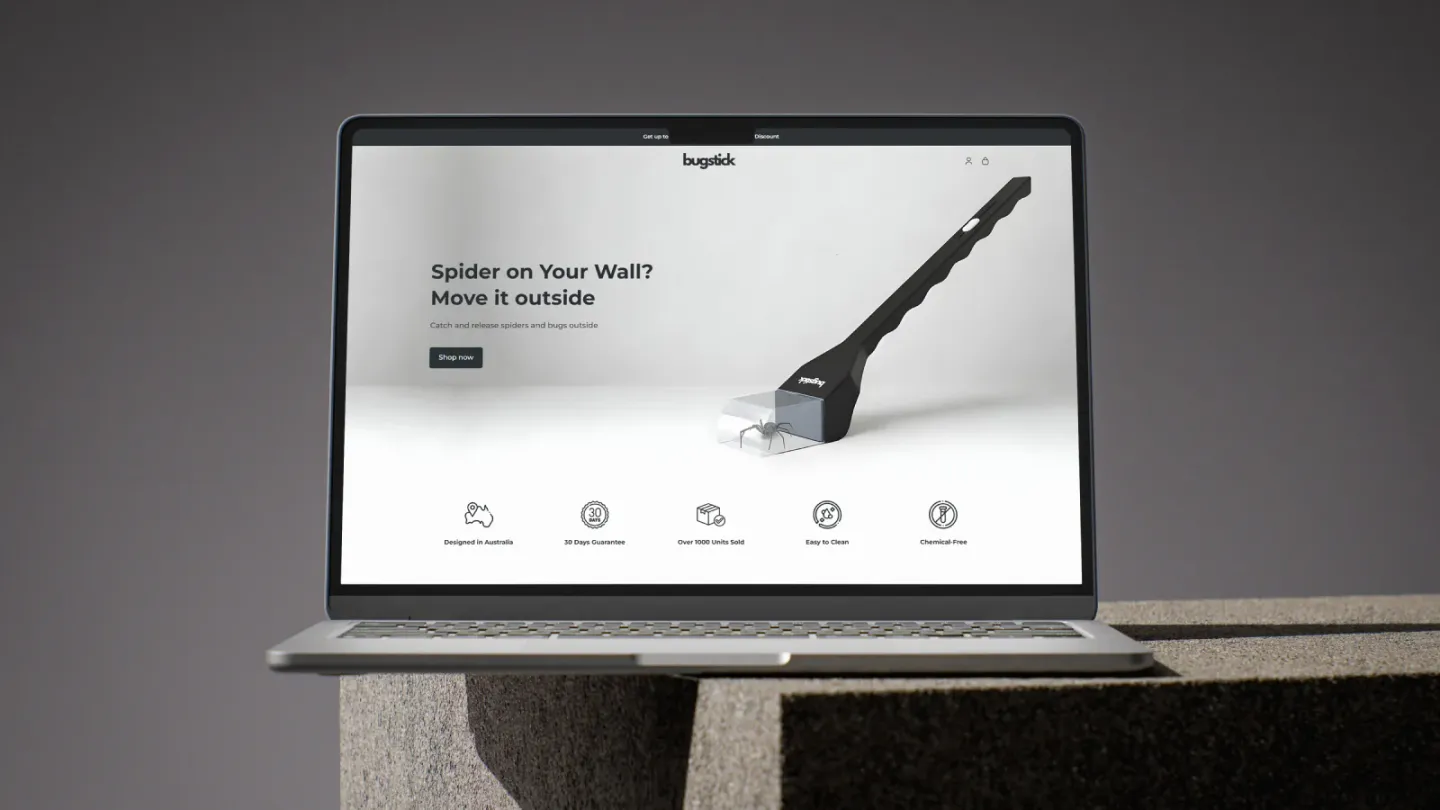
The storefront
The Bugstick store as it runs today, at getbugstick.com. Screens change; this page describes the build rather than the current merchandising.
Open live siteThe challenge
Viral attention is a spike, not a channel. A thread or a clip sends a burst of traffic with no purchase intent attached, at an unpredictable hour, to a store selling a single low-priced item.
Two things follow, and both are merchandising problems rather than traffic problems: a product priced around twenty dollars cannot absorb its own shipping, and a visitor who arrived from a video has no reason yet to believe the thing works.
The approach
We worked on the existing store rather than replacing it, which meant the job was diagnosis before design. We looked for where the customer journey lost people, improved the shopping pages that carried the most weight, and refined usability in the places that decided whether a first-time visitor from social media stayed long enough to understand the product.
That work continues as maintenance and optimisation rather than ending at a launch date, because a store carrying unpredictable traffic spikes needs attention after the redesign, not just during it.
What we did on this engagement
What the build carries
Three structural decisions do most of the work in this store. Each one is a constraint the design had to satisfy rather than a feature added at the end.
Shopify
The existing platform. The engagement improved the store on it rather than moving off it.
Cart drawer with a shipping threshold
A feature of the store as we found it. The threshold is unit-based rather than value-based.
Social proof wall
Quotes drawn from Kickstarter, Reddit, Instagram and TikTok, doing the trust work a brand reputation would otherwise do.
Notes from the build
A redesign, not a rebuild
The store existed before we did. Our work was to find where the customer journey lost people, improve the pages that mattered most, and keep improving them since — not to replace a platform that was already doing its job.
What belongs to the client
The trust strip, the shipping threshold, the in-cart upsell and the wall of social quotes are features of the client’s store, and the numbers on them are the client’s claims about their own business. They are described here as what the store does, not as outcomes we produced.
No figure on this page is presented as an outcome of our work. The engagement, scope and services listed above are the claims that are ours.
Questions this build answers
Four questions this project raised about building on Shopify, answered in the terms the work actually set.
Does a free-shipping threshold actually raise order value?
Usually, on a low-priced item where shipping is a large share of the total. The threshold gives a reason to add a second item that the shopper can act on immediately. It works less well on higher-priced goods, where the shipping cost is already small relative to the basket and the nudge reads as noise.
Should a threshold be based on order value or number of items?
A unit threshold asks for a second item; a value threshold asks for a bigger basket. Units are the clearer instruction for a single-product store, because the shopper knows exactly what satisfies it. Value thresholds suit wider catalogues where the shopper has genuine choice about how to reach the number.
How do you use social media reviews without misrepresenting them?
Attribute them plainly to the platform and person they came from, and never restate them as something they are not. A comment praising a product is not a review of the company that built the website, and presenting it as one is dishonest even when every individual quote is genuine.
What does a store need in place before a viral spike arrives?
Hosting that survives the burst, a product page that explains the thing to someone who has seen ten seconds of video, and a checkout that works on a phone at midnight. The traffic cannot be scheduled, so the preparation has to be structural rather than a campaign you switch on.
The services behind this build
Building something like Bugstick?
Whether it is a new store or one that already exists and needs work, the first conversation is about scope rather than a pitch.
We reply within one business day