AI product descriptions that don't damage accuracy

Generated product descriptions work when the model is given real product data and a house style, and fail when it is asked to invent. A model handed a specification sheet and example descriptions produces usable first drafts. A model handed only a product name produces plausible fiction, which on an ecommerce site means inaccurate claims about a physical object.
This is the automation we recommend starting with, for reasons covered in what to automate first: it pays back immediately and it fails safely, because mistakes are caught in review rather than by a customer.
It also fails badly when done carelessly, and the failure mode is worth understanding before you start.
The failure mode
A language model given a product name will produce a description. It will read well. It will be confident. And a portion of it will be invented, because the model has nothing factual to work from and generating plausible text is exactly what it does.
On a blog, an invented detail is an embarrassment. On an ecommerce site, it is a claim about a physical object that you then have to ship. “Water resistant to 50 metres” on a watch that is not, or “solid oak” on something veneered, is a consumer-protection problem before it is anything else.
The fix is not better prompting. It is better input.
Feed specifications, not names
Output quality tracks input quality almost linearly. Give the model:
- Every factual attribute you hold — dimensions, weight, materials, compatibility, capacity
- What is physically in the box
- Care, washing or maintenance instructions
- Any certifications or standards the product meets
- The supplier’s technical sheet, if you have one
Plus three or four of your existing descriptions that represent the voice you want, so the model matches your register rather than inventing one.
If a fact is not in the input, it must not appear in the output. State that explicitly in the instruction, and check for it in review.
Build review into the workflow
Not “we’ll check them” — an actual step, with an actual owner, before anything publishes.
The economics survive this easily. Reviewing thirty drafts is far faster than writing thirty descriptions from scratch, so the time saving remains substantial even with a careful review pass.
What the reviewer checks:
- Every factual claim traces to the input data. This is the whole point of the step.
- No invented certifications, standards or awards.
- Nothing about durability, safety or performance that you cannot support.
- Voice matches the rest of the catalogue.
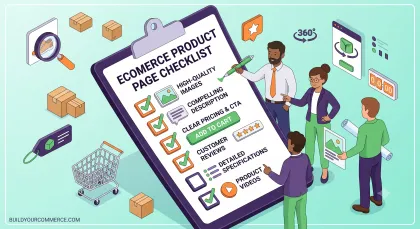
- The description answers the questions the product page checklist requires, particularly what is included.
Where to start
Products with no description at all, or with a single line copied from a supplier feed.
Those pages have the most to gain and least to lose. Many stores have hundreds of them — long-tail products nobody had time to write copy for, which consequently convert poorly and rank for nothing.
Do not start by rewriting your best-performing products. That risks your strongest pages to fix something that is not broken, and it is a surprisingly common instinct.
On search rankings
Generated copy is not penalised for having been generated. Search engines assess whether content is helpful, original and accurate — not how it was produced.
What has always been a liability is thin, near-identical copy across many products. Generation tools make producing that failure much faster, which is the real risk. A hundred products with the same three paragraphs and a swapped product name is a duplication problem whether a person or a model wrote it.
The mitigation is the same as it has always been: each description should contain facts specific to that product. If the only difference between two descriptions is the name, one of them is not earning its page.
What not to generate
- Safety claims, certifications, or regulatory statements. Ever.
- Anything in a regulated category — supplements, medical devices, cosmetics claims — without qualified review.
- Comparative claims about competitor products.
- Reviews or testimonials. This should not need saying, and it does.
A realistic workflow
- Export products missing descriptions, with all their attribute data
- Generate drafts against a fixed instruction and style examples
- Route drafts into a review queue, never straight to publish
- Reviewer checks against the five points above
- Approved copy publishes; rejected copy returns with a note on why
- Track rejection reasons — patterns tell you what to fix in the instruction
That sixth step is what makes this improve over time instead of staying at a fixed quality level.
Measure it
Before starting, record how long writing one description takes and how many products lack one. Afterwards, track drafts produced, drafts rejected, and the rejection reasons.
If the rejection rate stays high, the input data is insufficient — not the model. That distinction saves a lot of wasted iteration on prompts.
Handling variants and near-identical products
The hardest case, and the one most likely to produce duplication.
A catalogue with forty variations of the same product — sizes, colours, capacities — cannot support forty genuinely distinct descriptions, and pretending otherwise produces exactly the thin near-duplicate content that causes problems.
The right structure is usually one product page with variants, not forty pages. Where the platform or the business genuinely needs separate pages, the description should focus on what differs, with shared information handled once as structured data rather than repeated as prose.
If you cannot articulate what makes two products different, that is a signal about the catalogue structure rather than a copywriting problem.
Keeping the house style consistent
Generated copy drifts toward a generic register unless anchored. Two things keep it consistent.
Style examples in the instruction. Three or four real descriptions you are happy with, provided every time. This does more than any amount of adjective instruction.
An explicit banned list. The words your brand does not use. Most brands have them, few write them down. Ours are in our own style guide and the same discipline applies to generated product copy.
Review the output periodically as a set rather than individually. Drift is invisible one description at a time and obvious across twenty.
A note on translation
The same principles apply, with one addition: a generated translation needs review by somebody who speaks the language and knows the product category.
Translation errors in product copy are not merely awkward. Sizing, materials, care instructions and safety information all carry real consequences when mistranslated, and the categories where translation is most commercially attractive are often the categories where errors matter most.
Who should own this
Not the person who set up the tool. The person who owns product content.
That distinction matters because the failure mode is editorial rather than technical. The workflow will keep producing drafts indefinitely; what determines whether the output is any good is whether somebody with judgement about your products is reading them before publication, and whether they are feeding rejection patterns back into the instruction.
In practice that is usually whoever writes product copy today. The automation does not replace them — it removes the blank page and leaves them editing, which is faster and generally more pleasant work.